We take your privacy seriously. By clicking the "Submit" button, you are providing your electronic signature and consenting to Resolve Federal Tax Group's Terms of Service and Privacy Policy. You are consenting to Resolve Federal Tax Group's service providers contacting you with information and offers at the phone number provided using an automated system, pre-recorded messages, and/or text messages. Consent is not required as a condition of purchase. Message and data rates may apply.
IRS Fresh Start Program Guide
Dealing with unpaid federal taxes can be stressful, especially when penalties, interest, and collection notices continue to increase the amount you owe. Fortunately, the IRS Fresh Start Program offers several options that may help eligible taxpayers manage their tax debt and get back on track.
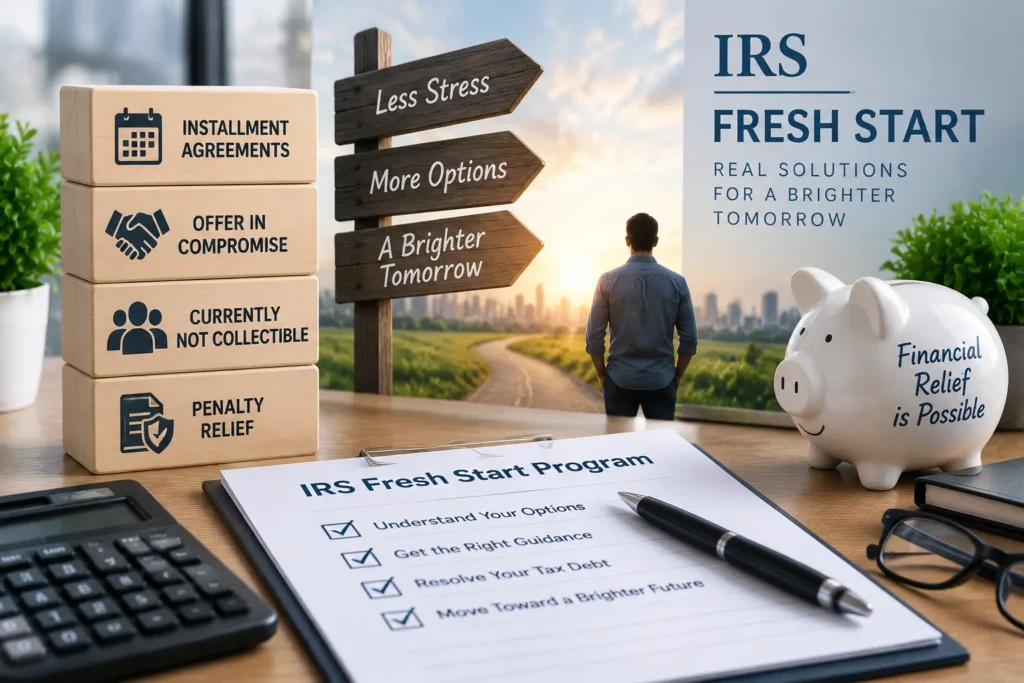
The IRS Fresh Start program is not a one-off program or automatic tax-debt relief program. Rather, it is defined as a set of modifications and current IRS programs aimed at simplifying the process of taxpayers who qualify to settle their tax liabilities. You can pay your balance in an installment agreement depending on your financial condition, you can request an Offer in Compromise or relief when it would be a financial burden to pay the full amount.
This IRS Fresh Start Program Guide explains how these options work, who may qualify, what requirements you should understand, and how to approach the process.
What Is the IRS Fresh Start Program?
IRS Fresh Start Program is a term that is often used to refer to IRS programs that broadened or streamlined some of their tax-debt relief programs. The idea is to assist qualified taxpayers to settle federal tax debt without undue collection pressure.
The Fresh Start provisions have rendered some taxpayers to be subjected to more manageable payment plans and have enhanced flexibility in some IRS collection programs. Nonetheless, IRS does not just cancel tax debt due to the fact that one requests Fresh Start relief.
Rather, taxpayers usually have to prove that they satisfy certain criteria according to their tax debt, income, expenses, assets, and capacity to pay.
The correct answer lies in your situation. An installment agreement can be of benefit to a person who is able to afford monthly payments, whereas a taxpayer with severe financial difficulties may have to consider an Offer in Compromise or Currently Not Collectible status.
Who May Qualify for Fresh Start Relief?
The eligibility will vary depending on the type of tax-relief you are interested in. The IRS will look at the amount you are owed, whether you have filed your tax returns, your current income, your assets and your capacity to pay.
In most cases, taxpayers are advised to ensure that their necessary federal tax returns are submitted before they can claim most payment or settlement options. There are also other filing and payment requirements that may be required by the businesses.
An illustration is that a taxpayer who has relatively manageable balance and whose income is consistent may be eligible to a streamlined installment agreement. A different taxpayer who has limited income and high expenses that he or she needs might have a reason to seek alternative collection relief.
It is important to understand that IRS Fresh Start eligibility is not determined by income alone. Your complete financial picture can affect which option is available and how much you may be expected to pay.
IRS Installment Agreements
An installment agreement allows qualified taxpayers to pay their federal tax debt in installments instead of paying the full amount at once.
This may be helpful in cases whereby you have sufficient income to pay monthly payments yet you cannot afford to pay the entire amount of your tax liability at the same time. The IRS can provide various forms of payment arrangements depending on the situation.
An installment agreement can be streamlined, which can be especially beneficial since it might need less financial documentation than more complicated ones. The sum of money you owe and the conditions of the contract determine your eligibility.
Before requesting an installment agreement, calculate how much you can realistically afford each month. Choosing a payment that is too high could create additional financial problems, while a payment that is too low may not satisfy IRS requirements.
The interest and some penalties may be paid until the balance is paid off.
Offer in Compromise
One of the most popular IRS tax-relief options is an Offer in Compromise (OIC). It enables an eligible taxpayer to pay a tax debt that is less than the amount owed to the IRS when certain conditions of the IRS are fulfilled.
However, an Offer in Compromise is not automatically available simply because you cannot afford your tax bill.
The IRS usually considers the amount offered as compared to what it reasonably believes to receive according to the financial situation of the taxpayer. The agency can take into consideration the income, expenditure, assets, and future paying capacity.
There are different circumstances under which an OIC may be considered, including situations involving doubt about liability, doubt about collectibility, or circumstances where requiring full payment would create an exceptional situation.
Due to the fact that the application may require some detailed financial information, taxpayers are advised to read the eligibility requirements thoroughly before making an offer.
Currently Not Collectible Status
There are taxpayers who are actually unable to pay since they will not be able to cover their IRS debt as they will not be able to afford the essentials of life.
Under such circumstances, the taxpayer can possibly request Currently Not Collectible (CNC) status.
In case the IRS grants CNC status, the collection activity can be put on hold until the financial position of the taxpayer is in a position to pay. This however does not usually cancel the underlying tax debt.
The interest and penalties can still be applied and the IRS can revisit the financial situation of the taxpayer in the future. Collection action may also be undertaken by the agency in case of a change of circumstances.
CNC status is therefore better understood as temporary collection relief rather than tax forgiveness.
Penalty Relief Under Fresh Start Options
Sanctions have the potential to drastically augment an outstanding tax debt. There are situations where taxpayers can be relieved of IRS penalties.
Another possibility is the First Time Abate that might be offered to taxpayers with a history of filing and paying their taxes responsibly but who received some penalties the first time.
There are other provisions of penalty relief whereby the taxpayers can prove that they had reasonable cause to fail to pay a tax obligation. Examples may be some severe situations that did not allow complying in time.
There are certain rules in relation to penalty reliefs and not all penalties can be eliminated. Taxpayers are required to determine the nature of the penalty charged and whether the requirements of relief are met.
Reducing penalties can sometimes make an existing payment arrangement more manageable.
How to Apply for IRS Fresh Start Relief
The first step is to understand exactly how much you owe and which tax periods are involved. You should also make sure your tax returns are filed and that your financial information is accurate.
Then, consider the existing IRS collection options. Think about the possibility of paying the balance in full, paying monthly, or consider a settlement or hardship-based option.
You can apply online, file IRS forms, or call the IRS depending on the option. More complicated situations can require detailed financial documentation.
Do not provide false information on income, expense, and asset. Financial information can be verified by the IRS and any wrong information may lead to delays or issues with your application.
In case you do not know which one is suitable to your situation, you may want to seek the counsel of a skilled tax professional who is knowledgeable about the IRS collection process.
Documents You May Need
The type of relief you request will determine the documentation you need. Typical financial documents can be pay statements, bank statements, mortgage or rent, car expenses, insurance bills, and other living expenses.
Self-employed taxpayers might be required to submit business income and expenses information. The IRS can also demand details of investments, retirement plans, property, cars, and other properties.
Maintaining proper records may simplify the application process and allow you to know how much you can really afford.
Check your information before you make an application. The slightest mistakes in calculating incomes or expenses may influence how the IRS evaluates your financial status.
Common IRS Fresh Start Mistakes to Avoid
One of the biggest misconceptions is that the IRS Fresh Start Program automatically eliminates tax debt. It does not. Taxpayers must qualify for a specific relief option and comply with its requirements.
The other frequent error is disregarding IRS notices. Collection notices are not to be neglected as deadlines and enforcement measures may be important.
Taxpayers are also not to accept the payment amounts that they cannot afford. The situation can be complicated by a payment arrangement that defaults on a regular basis.
Another major issue is not filing the future tax returns. The majority of relief programs have the condition that taxpayers must continue to pay their current taxes.
Finally, be cautious of companies promising guaranteed tax-debt elimination. No legitimate service can guarantee that the IRS will accept a particular settlement or erase a taxpayer’s balance.