
We take your privacy seriously. By clicking the "Submit" button, you are providing your electronic signature and consenting to Resolve Federal Tax Group's Terms of Service and Privacy Policy. You are consenting to Resolve Federal Tax Group's service providers contacting you with information and offers at the phone number provided using an automated system, pre-recorded messages, and/or text messages. Consent is not required as a condition of purchase. Message and data rates may apply.
How Does Form 1098-T Help College Students?
College expenses can quickly add up, from tuition and textbooks to other education-related costs. Fortunately, eligible students and their families may qualify for tax benefits that help reduce these expenses. One important document that can help is Form 1098-T, Tuition Statement.
Colleges and universities use this form to report certain information about tuition payments and scholarships. Students and parents can use it when preparing tax returns and determining whether they qualify for education tax credits.
Understanding Form 1098-T can help students in organizing their financial data, prevent tax errors, and discover possible savings. In this article we can understand how it works and why it matters.
What Is Form 1098-T?
Form 1098-T is a tax form that is usually submitted by eligible educational institutions to students to disclose some information on tuition. It assists students and their families in finding out whether they can receive federal education tax benefits or not.
The form contains information regarding the school, the student, eligible tuition fees and scholarships or grants. It is usually given to students at the end of January after the tax year.
Nevertheless, the receipt of Form 1098-T does not necessarily mean a tax credit or refund. Qualification is based on income, enrollment status, qualified expenses, and dependency status.
Students should also remember that the form may not include every expense eligible for a tax credit. Keeping tuition statements, receipts, and financial aid records can help them calculate their benefits accurately.
How Does Form 1098-T Help College Students?
Form 1098-T simplifies the tax preparation process by offering valuable information on the cost of education and financial aid.
Here are its key advantages:
- Identifies possible tax credits: Students and eligible parents have the opportunity to research education tax credits using the information.
- Organize financial documents: The form will give a handy overview of some tuition-related payments and scholarships.
- Supports accurate tax filing: The students will be able to check the reported figureswith the receipts and school accounts statements.
- Clarifies financial assistance: Scholarship and grant details assist taxpayers to learn how financial aid can influence eligible expenses.
- Helps families plan ahead: Parents paying college expenses can evaluate potential tax savingsand budget for future education costs.
Although the Form 1098-T is helpful, taxpayers must consider their entire financial records and not just the form.
How Form 1098-T Helps Students Qualify for Tax Credits
One of the greatest benefits of Form 1098-T, one can single out the fact that it allows students and their families to estimate their eligibility to two federal education tax credits.
American Opportunity Tax Credit (AOTC)
The American Opportunity Tax Credit is available to eligible students during their first four years of higher education. It provides a maximum annual credit of $2,500 per eligible student.
The credit is calculated using 100% of the first $2,000 in qualified expenses and 25% of the next $2,000. Eligible taxpayers may be eligible to claim up to 40% as a refund, by IRS rules.
Qualified expenses typically cover allowable tuition, mandatory fees, and some course materials. Income limits and other requirements apply.
Lifetime Learning Credit (LLC)
Lifetime Learning Credit may assist the qualified undergraduate, graduate, and professional students, even those undertaking qualifying courses to enhance job skills.
It offers a credit of up to $2,000 per tax return, calculated as 20% of up to $10,000 in qualified education expenses. This credit cannot be refunded.
Form 1098-T assists taxpayers to review education costs in the event of such credits. Nonetheless, they are usually not in a position to claim the same student in the same tax year in both credits.
Understanding the Important Boxes on Form 1098-T
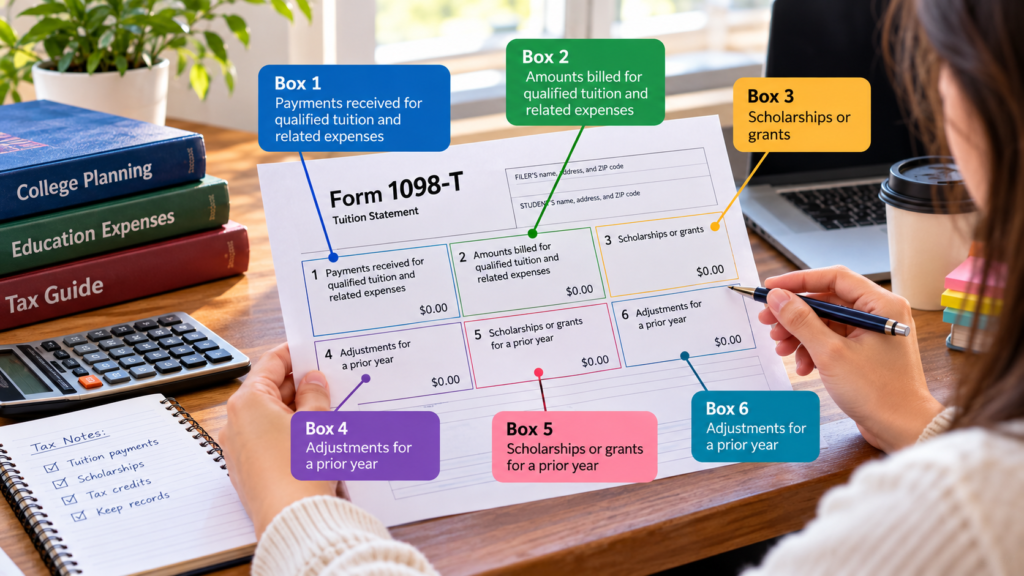
Understanding which boxes to review can make Form 1098-T easier to understand.
- Box 1: Payments Received for Qualified Tuition and Related Expenses. This box generally reports payments the institution received during the tax year for qualified tuition and related expenses. Compare the amount with your school account statements.
- Box 5: Scholarships or Grants. This box records scholarships and grants that are processed or administered by the institution. Such sums can cut down on the costs that can be used on education tax credits.
- Box 8: At Least Half-Time Student. This box will show whether the student was enrolled at least half-time, which may influence the eligibility to the American Opportunity Tax Credit.
- Box 9: Graduate Student. This box identifies students who are taking graduate-level programs and can be used to identify what tax benefits are applicable.
Students are advised to verify the information and report to the student accounts office at their school in case of any mistakes. Other receipts might be required to ascertain their total qualified expenses.
Who Can Benefit From Form 1098-T?
Form 1098-T can help different people depending on who pays the education expenses and who claims the student on a tax return.
- College students: Students paying their own expenses may use the form to evaluate their eligibility for education tax credits.
- Parents and guardians: Parents claiming an eligible student as a dependent may qualify for education tax credits if they meet IRS requirements.
- Graduate students: Students who are taking advanced degrees can use the form when considering eligibility to Lifetime Learning Credit.
- Part-time students: Part-time students can be eligible to receive education tax benefits, based on the requirements.
- Families receiving financial aid: Parents and students can review scholarships and grants to understand their effect on eligible expenses.
Not everyone who receives Form 1098-T qualifies for a credit. Income limits, enrollment requirements, and other tax rules determine eligibility.
Common Mistakes to Avoid When Using Form 1098-T
Students can avoid unnecessary tax complications by watching out for these common mistakes.
- Assuming a refund is guaranteed: The form does not automatically qualify a student for a refund or tax credit.
- Ignoring other costs: There are other books, supplies and equipment needed that can be qualified even without being listed in the amount of tuition that is reported.
- Ignoring scholarships: Financial aid may reduce the expenses eligible for tax credits.
- Claiming expenses twice: The same expenses generally cannot be used to claim multiple tax benefits.
- Forgetting supporting documents: Keep receipts, tuition statements, and scholarship records to support your calculations.
Reviewing these details can help students prepare accurate tax returns and avoid missing eligible benefits.
Get Help With Your IRS Tax Problem Start Here.
Contact us today for a free consultation and let us help you resolve your tax problems.