We take your privacy seriously. By clicking the "Submit" button, you are providing your electronic signature and consenting to Resolve Federal Tax Group's Terms of Service and Privacy Policy. You are consenting to Resolve Federal Tax Group's service providers contacting you with information and offers at the phone number provided using an automated system, pre-recorded messages, and/or text messages. Consent is not required as a condition of purchase. Message and data rates may apply.
IRS Fresh Start Program Guide
Dealing with unpaid federal taxes can be stressful, especially when penalties, interest, and collection notices continue to increase the amount you owe. Fortunately, the IRS Fresh Start Program offers several options that may help eligible taxpayers manage their tax debt and get back on track.
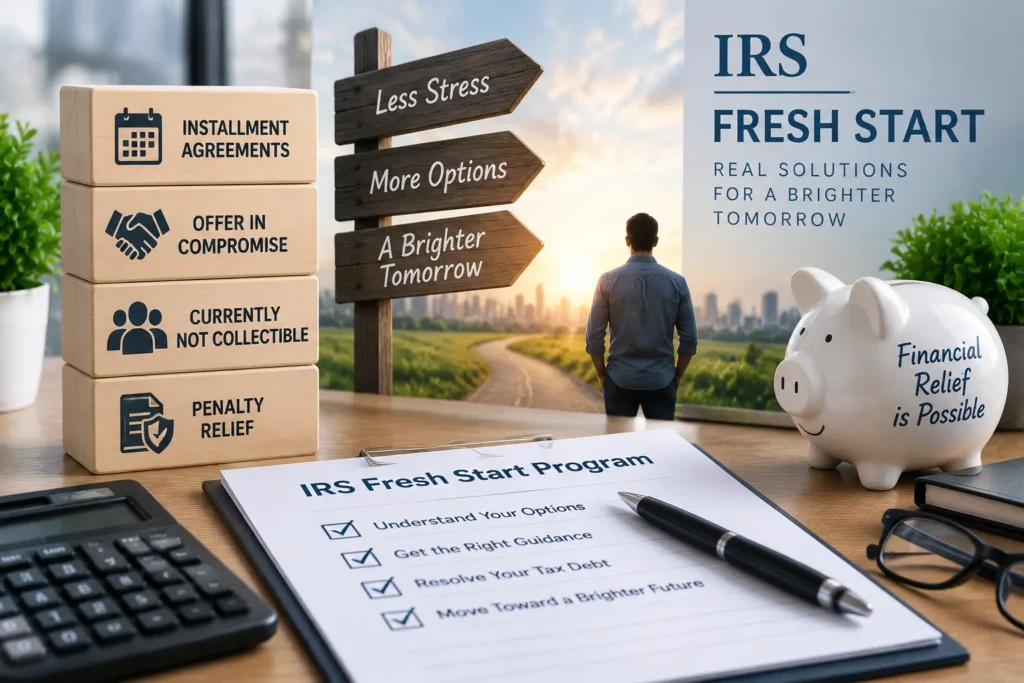
The IRS Fresh Start program is not a one-off program or automatic tax-debt relief program. Rather, it is defined as a set of modifications and current IRS programs aimed at simplifying the process of taxpayers who qualify to settle their tax liabilities. You can pay your balance in an installment agreement depending on your financial condition, you can request an Offer in Compromise or relief when it would be a financial burden to pay the full amount.
This IRS Fresh Start Program Guide explains how these options work, who may qualify, what requirements you should understand, and how to approach the process.
What Is the IRS Fresh Start Program?
IRS Fresh Start Program is a term that is often used to refer to IRS programs that broadened or streamlined some of their tax-debt relief programs. The idea is to assist qualified taxpayers to settle federal tax debt without undue collection pressure.
The Fresh Start provisions have rendered some taxpayers to be subjected to more manageable payment plans and have enhanced flexibility in some IRS collection programs. Nonetheless, IRS does not just cancel tax debt due to the fact that one requests Fresh Start relief.
Rather, taxpayers usually have to prove that they satisfy certain criteria according to their tax debt, income, expenses, assets, and capacity to pay.
The correct answer lies in your situation. An installment agreement can be of benefit to a person who is able to afford monthly payments, whereas a taxpayer with severe financial difficulties may have to consider an Offer in Compromise or Currently Not Collectible status.
Who May Qualify for Fresh Start Relief?
The eligibility will vary depending on the type of tax-relief you are interested in. The IRS will look at the amount you are owed, whether you have filed your tax returns, your current income, your assets and your capacity to pay.
In most cases, taxpayers are advised to ensure that their necessary federal tax returns are submitted before they can claim most payment or settlement options. There are also other filing and payment requirements that may be required by the businesses.
An illustration is that a taxpayer who has relatively manageable balance and whose income is consistent may be eligible to a streamlined installment agreement. A different taxpayer who has limited income and high expenses that he or she needs might have a reason to seek alternative collection relief.
It is important to understand that IRS Fresh Start eligibility is not determined by income alone. Your complete financial picture can affect which option is available and how much you may be expected to pay.
IRS Installment Agreements
An installment agreement allows qualified taxpayers to pay their federal tax debt in installments instead of paying the full amount at once.
This may be helpful in cases whereby you have sufficient income to pay monthly payments yet you cannot afford to pay the entire amount of your tax liability at the same time. The IRS can provide various forms of payment arrangements depending on the situation.
An installment agreement can be streamlined, which can be especially beneficial since it might need less financial documentation than more complicated ones. The sum of money you owe and the conditions of the contract determine your eligibility.
Before requesting an installment agreement, calculate how much you can realistically afford each month. Choosing a payment that is too high could create additional financial problems, while a payment that is too low may not satisfy IRS requirements.
The interest and some penalties may be paid until the balance is paid off.
Offer in Compromise
One of the most popular IRS tax-relief options is an Offer in Compromise (OIC). It enables an eligible taxpayer to pay a tax debt that is less than the amount owed to the IRS when certain conditions of the IRS are fulfilled.
However, an Offer in Compromise is not automatically available simply because you cannot afford your tax bill.
The IRS usually considers the amount offered as compared to what it reasonably believes to receive according to the financial situation of the taxpayer. The agency can take into consideration the income, expenditure, assets, and future paying capacity.
There are different circumstances under which an OIC may be considered, including situations involving doubt about liability, doubt about collectibility, or circumstances where requiring full payment would create an exceptional situation.
Due to the fact that the application may require some detailed financial information, taxpayers are advised to read the eligibility requirements thoroughly before making an offer.
Currently Not Collectible Status
There are taxpayers who are actually unable to pay since they will not be able to cover their IRS debt as they will not be able to afford the essentials of life.
Under such circumstances, the taxpayer can possibly request Currently Not Collectible (CNC) status.
In case the IRS grants CNC status, the collection activity can be put on hold until the financial position of the taxpayer is in a position to pay. This however does not usually cancel the underlying tax debt.
The interest and penalties can still be applied and the IRS can revisit the financial situation of the taxpayer in the future. Collection action may also be undertaken by the agency in case of a change of circumstances.
CNC status is therefore better understood as temporary collection relief rather than tax forgiveness.
Penalty Relief Under Fresh Start Options
Sanctions have the potential to drastically augment an outstanding tax debt. There are situations where taxpayers can be relieved of IRS penalties.
Another possibility is the First Time Abate that might be offered to taxpayers with a history of filing and paying their taxes responsibly but who received some penalties the first time.
There are other provisions of penalty relief whereby the taxpayers can prove that they had reasonable cause to fail to pay a tax obligation. Examples may be some severe situations that did not allow complying in time.
There are certain rules in relation to penalty reliefs and not all penalties can be eliminated. Taxpayers are required to determine the nature of the penalty charged and whether the requirements of relief are met.
Reducing penalties can sometimes make an existing payment arrangement more manageable.
How to Apply for IRS Fresh Start Relief
The first step is to understand exactly how much you owe and which tax periods are involved. You should also make sure your tax returns are filed and that your financial information is accurate.
Then, consider the existing IRS collection options. Think about the possibility of paying the balance in full, paying monthly, or consider a settlement or hardship-based option.
You can apply online, file IRS forms, or call the IRS depending on the option. More complicated situations can require detailed financial documentation.
Do not provide false information on income, expense, and asset. Financial information can be verified by the IRS and any wrong information may lead to delays or issues with your application.
In case you do not know which one is suitable to your situation, you may want to seek the counsel of a skilled tax professional who is knowledgeable about the IRS collection process.
Documents You May Need
The type of relief you request will determine the documentation you need. Typical financial documents can be pay statements, bank statements, mortgage or rent, car expenses, insurance bills, and other living expenses.
Self-employed taxpayers might be required to submit business income and expenses information. The IRS can also demand details of investments, retirement plans, property, cars, and other properties.
Maintaining proper records may simplify the application process and allow you to know how much you can really afford.
Check your information before you make an application. The slightest mistakes in calculating incomes or expenses may influence how the IRS evaluates your financial status.
Common IRS Fresh Start Mistakes to Avoid
One of the biggest misconceptions is that the IRS Fresh Start Program automatically eliminates tax debt. It does not. Taxpayers must qualify for a specific relief option and comply with its requirements.
The other frequent error is disregarding IRS notices. Collection notices are not to be neglected as deadlines and enforcement measures may be important.
Taxpayers are also not to accept the payment amounts that they cannot afford. The situation can be complicated by a payment arrangement that defaults on a regular basis.
Another major issue is not filing the future tax returns. The majority of relief programs have the condition that taxpayers must continue to pay their current taxes.
Finally, be cautious of companies promising guaranteed tax-debt elimination. No legitimate service can guarantee that the IRS will accept a particular settlement or erase a taxpayer’s balance.
What Is the Taxpayer Advocate Service (TAS) and What Can’t It Do for You?
The Taxpayer Advocate Service (TAS) is an independent organization within the Internal Revenue Service (IRS) that helps taxpayers resolve certain problems they are unable to solve through normal IRS channels. It also works to protect the rights of taxpayers and detect problems in the tax system that might be causing problems to individuals and businesses.
Introduction
TAS offers its services to qualified taxpayers at no cost. It is not intended to substitute the IRS but assist taxpayers in challenging circumstances and make sure that their issues are properly resolved.
TAS is not related to the IRS offices, which process returns, provide audits, and collect taxes, although it is a part of IRS. This will enable TAS to represent taxpayers and collaborate with the relevant IRS departments to address qualifying concerns.
Why Was the Taxpayer Advocate Service Created?
The federal tax system may be complex and there are taxpayers who have issues that cannot be easily sorted out. Phone calls might not give a solution, letters might take a long time or an IRS problem might not be resolved even after trying to rectify it several times.
The Taxpayer Advocate Service was created to provide an additional level of assistance in these situations. Its mission is based on two main aspects, which are to assist individual taxpayers in solving severe problems related to the IRS and to identify more general problems that impact a large number of taxpayers.
When TAS discovers recurring problems, it can recommend changes to IRS procedures or tax administration. By so doing, TAS does not just help individual taxpayers. It also strives to enhance the general taxpayer experience.
When Can TAS Help You?
TAS is not designed to cover all tax questions or regular IRS requests. Generally, taxpayers should first attempt to resolve their problems through normal IRS procedures.
However, TAS may be able to help when a taxpayer is experiencing significant financial difficulty, an unusually long delay, or another serious problem that has not been resolved through regular IRS channels.
For example, TAS could be suitable in situations where an unresolved IRS problem is causing financial distress, where the IRS has not responded within a reasonable time, or where an IRS system or process is causing an unusual problem.
The eligibility is determined by the circumstances of each case. Hence, taxpayers must be aware of the conditions prior to assuming that TAS will grant their request of assistance.
How Can TAS Help Taxpayers?
When TAS accepts a case, a taxpayer advocate can review the situation and work with the taxpayer and appropriate IRS personnel to seek a resolution.
TAS can assist in delayed refunds, tax account issues, collection issues, IRS notices, payment issues, and other issues that qualify.
An advocate can clarify what information or documentation is required, contact the representatives of the IRS, and track the case.
TAS can also assist taxpayers to be more familiar with their rights and responsibilities. It is however, to help in a fair resolution and not necessarily to support the taxpayer or ensure a certain outcome.
What Are Your Taxpayer Rights?
The Taxpayer Advocate Service is significant in safeguarding the Taxpayer Bill of Rights. These rights provide basic safeguards to individuals who have to deal with the IRS.
Taxpayers have the right to be informed, receive quality service, pay no more than the correct amount of tax, and challenge the IRS’s position and be heard.
They also have rights related to appealing IRS decisions, privacy, confidentiality, professional representation, finality, and a fair and just tax system.
Being aware of these rights can assist taxpayers in becoming aware of when an IRS issue might need further consideration. It may also assist them to communicate better with the IRS and know what they can reasonably expect when going through the process of resolving the tax.
What Can’t TAS Do for You?
Although TAS is potentially a useful resource, it has significant drawbacks. It cannot just do away with a tax issue since a taxpayer is dissatisfied with an IRS ruling.
For example, TAS is usually unable to alter tax laws, cancel a legally due tax debt without a valid legal reason, or assure that a taxpayer will obtain a refund.
TAS is also not sure that all cases will be accepted. The service is based on certain eligibility and acceptance of cases.
Most importantly, contacting TAS does not mean that a taxpayer automatically wins a dispute with the IRS. TAS advocates must work within applicable tax laws and IRS procedures.
The service is not meant to be a short cut to tax requirements, but to assist in solving qualifying problems.
Can TAS Eliminate Tax Debt or Penalties?
The first myth is that TAS is able to automatically remove tax debt, penalties, or interest. The fact is that TAS is not a tax debt forgiveness program.
An advocate can assist taxpayers in knowing the options they have and talking to the IRS about their case. Any reduction or elimination of tax debt, penalties or interest should however be substantiated by relevant tax legislation, regulations or IRS procedures.
Financial information, documentation or other evidence may be required by a taxpayer to justify a request.
Therefore, taxpayers are not supposed to contact TAS hoping that their tax debt will vanish. Rather, TAS can be considered as an advocacy tool that can assist qualified taxpayers in overcoming challenging IRS issues and seek suitable remedies.
Can TAS Speed Up a Tax Refund?
The postponement of a tax refund may cause severe financial strain especially when the taxpayer is relying on the funds to cover basic costs. TAS can be used in some situations to help taxpayers who have qualifying refund delays.
TAS however does not assure that the refund is to be issued instantly.
Before issuing a refund, the IRS might require the completion of identity verification, an examination of a tax return, review of supporting documents, or other matters. TAS is not able to bypass necessary IRS procedures.
Taxpayers are also advised to realize that not all delayed refunds automatically qualify as TAS. The conditions of the delay and its effect on the taxpayer are significant aspects.
In case a refund delay is causing serious distress or an unresolved IRS issue, TAS might be a possible option to consider.
Can TAS Represent You in Tax Court?
TAS assistance is not to be confused with contracting a private tax attorney or tax professional to represent them in court.
A taxpayer advocate is able to collaborate with qualified taxpayers to address qualifying issues with the IRS. TAS is however not an alternative to an attorney where a case needs a special legal representation or litigation.
In case a taxpayer is in a legal court process or requires legal consultation concerning a complicated tax matter, it might be reasonable to seek the services of a qualified tax professional.
This distinction is significant since TAS is more oriented to solving IRS issues and safeguarding the rights of taxpayers. It does not offer all the forms of tax representation that a private professional can offer.
How Can You Request Help From TAS?
Taxpayers are expected to make reasonable attempts to solve their issue on their own with the IRS before seeking the assistance of TAS. Retain copies of tax returns, IRS notices, letters, payment records, and any other documents that have been previously submitted.
In case the problem is not solved and seems to correspond to the TAS requirements, a taxpayer may seek the help of the service. This is usually done using Form 911, Request for Taxpayer Advocate Service Assistance.
Be clear and precise when making a request. Provide an explanation of what occurred, what actions you have already undertaken, how the issue is impacting you, and what action you have received in response to the IRS.
Remember that making a request does not mean that TAS will take the case. The service considers every case according to its eligibility and case acceptance conditions.
Is the Taxpayer Advocate Service Right for You?
Taxpayer Advocate Service may be a valuable tool to taxpayers who have a severe or unresolved issue with the IRS. Its free service may assist qualified taxpayers to communicate with the IRS, learn their rights, and strive to resolve problems that have become hard to manage by other means.
Meanwhile, TAS has definite boundaries. It cannot rewrite tax laws, cannot assure refunds or automatically wipe out legitimate tax debt or assure a successful resolution in all disputes.
TAS should be thought of as a problem-solving and taxpayer advocacy service, rather than a way to bypass the IRS. In case you have already attempted to solve an IRS, issue and are still facing a lot of delays, financial loss, or some other qualifying problem, TAS can be of assistance.
Knowing what TAS is and is not capable of will enable you to make realistic expectations and make the correct steps towards solving your tax problem.
What Is CBE Group?
If you have ever received a letter, phone call, or payment notice from CBE Group, you may be wondering, “What is CBE Group, and why are they contacting me?” CBE Group is a reputable debt collection and accounts receivable management enterprise in the US. It collaborates with companies, financial institutions, health care organizations, government agencies, and other companies to collect unpaid accounts and enhance the recovery of payments.
CBE Group belongs to CBE Companies, which has a long history of providing accounts receivable management, customer service and contact center solutions. Since 1933, the company has been in operation and has been able to come up with services that integrate both the traditional ways of collection with the use of modern technology and communication with the customers.
Knowing the activities of CBE Group can guide you on why you might be getting communication with the company and what to do in case you feel that you have an outstanding account.
What Is CBE Group?
CBE Group is an accounts receivable management and debt collection company. It is mainly used to assist organizations to recover money due on accounts that are not paid on time.
When customers owe a company money, it is common to engage collection agencies. Rather than dealing with all the overdue accounts in-house, a business can collaborate with a firm like CBE Group to deal with communication, payment terms, and recovery of accounts.
CBE Group can reach out to consumers over the phone, through mail, text, or any other form of communication based on the account and the relevant regulations. The aim of such communications is usually to negotiate on an outstanding balance and possible solutions to settle it.
The company has a wider scope of operation than traditional consumer debt collection since it serves businesses and government-related organizations as well.
When Was CBE Group Founded?
The history of CBE Group can be traced back to 1933 when the organization that came to be known as CBE Companies started its operations. The company has over 90 years of experience and has been in operation with significant transformations in the financial services and customer communication sectors.
The organization has grown over the years to be more than a conventional collection business to a wider provider of accounts receivable management, customer service and outsourced contact center services.
This long history has enabled CBE to embrace the emerging technologies as the collection industry has changed. Nowadays, the collection companies are more likely to resort to digital communication, automated systems, data analytics, online payment tools, and customer service technologies.
CBE Group’s long operating history is one reason the company is recognized as an established participant in the accounts receivable management industry.
What Services Does CBE Group Provide?
CBE Group offers a number of debt collection and accounts receivable management services. These services are aimed at assisting the organizations to recover the pending balances and stay in touch with their customers.
Third-party debt collection is one of the significant services. In this case, an organization can delegate an outstanding account to CBE Group to allow the company to contact the customer and seek to collect the balance.
CBE Group can also offer first-party collection services. Such services may include reaching out to customers earlier into the payment cycle, when an account is not so delinquent.
The company also employs various communication channels to access customers. These may consist of telephone conversations, written communications, text messages, email, automated systems, and other digital communications depending on the circumstances.
The use of technology and data analysis can assist the collection companies in organizing the accounts, finding the right communication strategies, and streamlining the recovery process.
Which Industries Does CBE Group Serve?
CBE Group is involved with companies across numerous key industries. Its services have encompassed financial services, healthcare, telecommunications, utilities, retail and government.
Collection services in the financial services industry may include unpaid loans, credit accounts and other financial obligations. Banks and other financial institutions can adopt special collection services to handle past due accounts.
Accounts receivable companies can also collaborate with healthcare organizations in cases of unpaid medical bills by patients. Collection services in telecommunication and utilities can be associated with outstanding phone, internet, electricity, or other service-related balances.
Retail businesses can avail collection services to some of their unpaid customer accounts, whereas government agencies can avail special recovery services to address eligible debts.
Because different industries have different billing systems and regulations, CBE Group’s services can be adapted to the type of account and organization involved.
Why Might CBE Group Contact You?
In case CBE Group calls you, it is possible that an organization has a balance that it believes you owe and has assigned or referred the balance to CBE to collect.
As an example, the original creditor might be a financial institution, health care provider, telecommunications company, utility provider, retailer or government organization.
Receiving a call or letter from CBE Group does not necessarily mean that you should immediately make a payment. The first thing you need to know is what the account is, who the original creditor is, how much is purportedly owed and whether the information is true.
In case you fail to identify the debt, believe that the amount is wrong or believe that the account is of another person, then you should review the information and think about your legal rights before paying.
It is also important to remember that scammers sometimes impersonate legitimate companies. If a communication seems suspicious, verify that it is genuinely from CBE Group before providing sensitive financial or personal information.
Is CBE Group a Legitimate Company?
Yes, CBE Group is a valid debt collection and accounts receivable management company. It belongs to CBE Companies, a well-established organization that has a history dating back to 1933.
However, consumers are still advised to check the specifics of any debt they are requested to pay. A valid collection agency is allowed to make contact with consumers regarding debts, but consumers possess rights in regard to the way debt collection messages are managed.
When you get a collection notice, check the details given attentively. Note the name of the original creditor, account details, amount claimed, and instructions on responding.
Do not give out sensitive information just because somebody calls you out of the blue. In case of doubt, confirm the identity of the company and the account independently and then proceed.
Understanding the difference between a legitimate collection attempt and a potential scam can help protect your personal and financial information.

What Should You Do If CBE Group Contacts You?
The initial one is to remain composed and collect facts. Do not be rushed into making a quick decision just because you were called or wrote to.
Request information concerning the account, such as the original creditor and the amount being claimed. Compare this information to your financial records.
In case you are aware of the account and you feel that the information is true, you can negotiate on the payment or resolution options. The outstanding balance can be dealt with in various ways depending on the situation.
In case you do not know the account or suspect that something is amiss, then you must challenge or enquire into the debt through the relevant procedure. Retain copies of letters, notices, payment records, and other correspondence to the account.
It is also prudent not to make promises or payments without knowing what is going on. In case the debt is complex or you feel that your rights have been infringed, then you may want to consult a reputable consumer law expert.
How Does CBE Group Handle Debt Collection?
CBE Group combines traditional accounts receivable practices with technology, data analysis, customer communication, and compliance processes.
Debt collection is no longer restricted to letters and phone calls. Businesses are moving towards electronic communication and automation to enable consumers to easily access their account details and payment methods.
The strategy of CBE Group incorporates various forms of communication that aim at reaching consumers using a channel that can be more convenient to them.
The company also focuses on the conformity to the relevant laws and regulations. This especially applies to the debt collection sector as the collection agencies are required to adhere to regulations that regulate consumer contacts, disclosures, privacy and debt recovery procedures.
To the consumer, this implies that knowing the role of CBE Group and the rights that they can enjoy can simplify collection communication.
CBE Group vs. CBE Companies: What Is the Difference?
CBE Group and CBE Companies are not exactly the same, although they can be confused with each other sometimes.
The larger organization is CBE Companies which offers services related to accounts receivable management, customer contact centers, customer service and business process solutions.
CBE Group is more specialized in debt collection and accounts receivable management. The other branches of the larger organization can focus on customer service and outsourced contact center services.
This distinction can help explain why you may see different CBE names in correspondence or other communications.
Regardless of the specific division involved, the organization operates in the broader financial services and customer contact industry.
How to Set Up a Payment Plan with the IRS
Owing money to the IRS can be stressful, especially if you cannot afford to pay your entire tax bill at once. The good news is that you may be able to set up an IRS payment plan and pay your tax debt over time.
An installment agreement, also known as an IRS payment plan, allows eligible taxpayers to pay their tax balance in installments rather than in a lump sum. Depending on your financial situation and the amount you owe, you may be able to apply online, by phone, or by submitting the appropriate IRS form.
This guide explains how to set up a payment plan with the IRS, who may qualify, how the application process works, and what happens after your plan is approved.
What Is an IRS Payment Plan?
An IRS payment plan is an arrangement that allows you to pay your federal tax debt by making smaller payments over a specified time. Instead of paying your full balance at once, the IRS can permit you to make monthly installments until you pay off the debt.
Interest and some penalties usually keep on accumulating as long as you have an outstanding tax. Therefore, establishing a payment plan may not ensure that the amount you owe from increasing.
The IRS offers a number of payment options. The best alternative will be based on the amount of your total tax debt, whether you are able to pay and the speed with which you will pay the balance.
Who Can Qualify for an IRS Payment Plan?
Many taxpayers with unpaid federal taxes can qualify for an installment agreement, but eligibility requirements vary depending on the type of plan.
To individuals, the IRS usually provides choices to taxpayers who can afford to pay the balance in a comparatively short time and those that require time. Certain payment plans can be done via a simplified application process and other cases might need more financial details.
You must ensure that you have submitted all the necessary tax returns before applying. You also need to know about the amount you owe and the amount you can afford to pay monthly.
In case you have not filed necessary returns, you might need to resolve your filing requirements before the IRS will agree to some payment arrangements.
How to Set Up a Payment Plan with the IRS
Setting up an IRS payment plan is usually straightforward if you know the basic steps.
Determine How Much You Owe
Begin by checking your IRS tax account and see what you owe. Your balance can consist of unpaid taxes, penalties and interest.
Being aware of the exact amount you owe will assist you in deciding on the payment option that could be suitable.
You should also check your budget and work out the amount you can afford to pay monthly. Choose an amount that is realistic and sustainable. Failure to make payments after setting up a payment plan may lead to further issues.
File All Required Tax Returns
Before submitting an IRS payment plan, ensure that you have submitted your required federal tax returns.
In case you have several years of unfiled returns, take care of those returns as soon as you can. Making your returns does not imply that you have to pay the full balance indicated on them at once.
Nevertheless, it is worth keeping up with your tax filing. When you have a payment plan, you usually have to keep up with the future tax payments to not default on the agreement.
Apply Through the IRS
The IRS online payment agreement system is the simplest method of application to many taxpayers.
The online application may enable qualified taxpayers to seek a payment plan, choose a monthly payment, choose a payment date, and provide the information required to form the agreement.
You can also apply by filling IRS Form 9465, Installment Agreement Request, depending on your circumstances.
In the case of a more complex situation, like a larger tax debt or inability to pay the necessary payments, the IRS may ask you to provide more financial information before approving an arrangement.
Choose an Affordable Monthly Payment
Your monthly payment should be based on what you can reasonably afford while still meeting your basic living expenses.
Higher monthly payment will enable you to settle your tax debt sooner and possibly less interest will be charged over time. Nevertheless, selecting a payment that is excessively high may render it hard to keep up.
Better to choose a sustainable amount of payment than to accept an amount that you cannot sustain.
Select Your Payment Method
There are various methods of paying to the IRS. Depending on your agreement, you can use direct debit using a bank account, payroll deduction, or other acceptable payment options.
Direct debit may be convenient as the payments are automatically deducted as per the agreed schedule. Make sure your account has sufficient funds to cover each payment.
Types of IRS Payment Plans
The IRS has different payment options based on taxpayers’ circumstances.
Short-term payment plans may be available to eligible taxpayers who can pay their balance within a relatively short period. These plans may be helpful in the situation when you require more time but are likely to pay the debt within a short period.
Long-term payment plans, commonly known as installment agreements, allow eligible taxpayers to make monthly payments over a longer period. The specific terms will be based on such factors as the amount of money you owe and your financial situation.
Individuals who are not able to pay the usual payment methods might be required to consider alternative IRS collection options. In other instances, the IRS can consider your financial position to determine whether you are eligible to a different arrangement.
Have Questions About IRS Payment Plans? Tell Us About Your Tax Situation Below.
How Much Does an IRS Payment Plan Cost?
IRS payment plan can include setup fees based on the kind of agreement and mode of payment you use. Certain taxpayers will be able to pay lower rates depending on their income.
Besides any setup fee, interest and some penalties usually remain on any unpaid amount of tax until the debt is paid off.
Due to this, one should know the overall cost of your payment scheme instead of concentrating on the monthly payment.
When you can afford it, you can pay a higher amount than the minimum so that you can have a smaller balance outstanding.

What Happens After Your Payment Plan Is Approved?
After you have been approved of your IRS payment plan, you have to abide by the terms of the agreement.
Pay all the payments on time and keep on filing your tax returns on time. You must also pay any new taxes you owe in good time.
When your financial situation alters, do not just cease to pay. Call the IRS and find out whether you can change your payment plan.
Failure to make a payment may lead to default of your agreement which may lead to further collection efforts.
Can You Pay Off an IRS Payment Plan Early?
Yes. When your financial position is better than it was, you may usually pay the outstanding balance of your taxes earlier than you had initially planned to do so.
As an example, you can get a bonus, tax refund or other income that enables you to pay a larger amount. The sooner you pay your balance; the less time you will be paying interest and other penalties.
Check your current IRS balance before making a big payment to be aware of the amount left in the balance.
Tips for Managing Your IRS Payment Plan
Keep Track of Your Payments
After you have a payment plan with IRS, it is important to keep things organized. Record all payments you make and frequently check your IRS account to ensure that payments are being recorded properly. You can consider establishing automatic payments, when possible, which will allow you to avoid deadlines.
Stay Current With Your Tax Obligations
When you get an unexpected amount of money, like a bonus, tax refund, or other additional funds, you might want to spend some of it to decrease your tax balance. Above all, keep paying your future taxes and also pay your current debt. In case you are not able to make a scheduled payment, reach out to the IRS immediately rather than neglecting the problem and letting your agreement to default.
Knowing how to establish a payment plan with the IRS can help to manage a daunting tax debt. The key is to know how much you owe, file your required tax returns, choose a payment amount you can comfortably afford, and apply for a suitable IRS payment plan.
Neglect not to pay a tax bill. Early action will provide you with a greater number of choices in settling your tax debt and prevent you from having to deal with a collection issue that you do not need.
When you are not sure what IRS payment plan is appropriate to you, especially when you have a large amount to pay or have a complex tax situation, you may want to consult a tax professional. They will be able to look into your situation and make you aware of the choices that you have.
Ready to Resolve Your IRS Tax Problem? Begin Here.
Get a free consultation today and take the first step toward resolving your tax problems.